Buying TRON Energy before each USDT transfer works fine — until you're the person doing it ten times a day. Or until a payout fails at 3 a.m. because a wallet ran dry and nobody was awake to top it up. That's the exact gap the TRON Energy subscription closes: instead of you watching your Energy balance, TronZap watches it for you and refills it automatically, around the clock.
Here's how the subscription works under the hood, why the magic number is 131,000 Energy, and the three ways to switch it on.
First, a 60-second refresher on Energy
TRON charges for transactions with two resources instead of a gas fee. Bandwidth covers the raw transaction data — every account gets 600 free points a day. Energy covers smart contract execution, and there's no free daily Energy at all.
USDT on TRON is a TRC-20 token, which means every USDT transfer is a smart contract call that consumes Energy:
- about 65,000 Energy if the recipient already holds USDT,
- about 131,000 Energy if the recipient has never held USDT before.
If the Energy isn't there, the network burns your TRX instead — roughly 6.5 TRX for a standard transfer and about 13 TRX for a fresh recipient at current rates. And if there's no TRX to burn either, the transfer fails with the OUT_OF_ENERGY error. So a wallet that sends USDT regularly needs a steady supply of Energy. The question is only whether you supply it manually or automatically.
What the subscription actually does
The mechanics are simple and fully automatic:
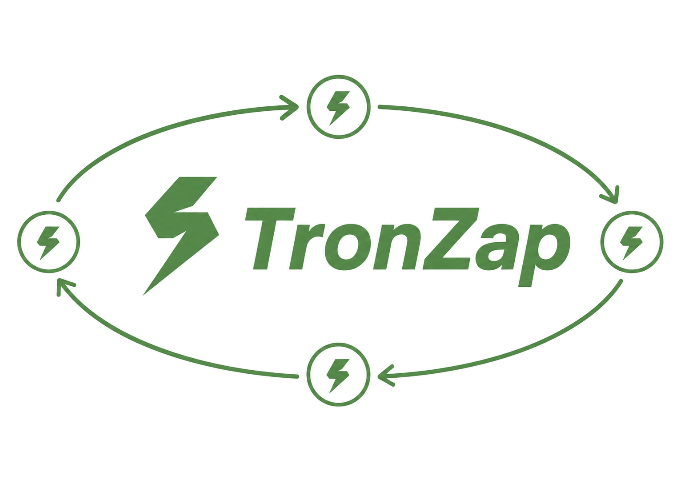
- Constant monitoring. Once you subscribe an address, TronZap starts checking its Energy balance continuously — 24 hours a day, 7 days a week. Not once an hour on a cron job — the address is under real-time watch.
- A fixed target: 131,000 Energy. The system's job is to keep the address at 131,000 Energy — the safe amount that covers a USDT transfer to any recipient, including brand-new ones.
- Instant top-ups. The moment your balance drops below the target — because you sent a transfer, or because a delegation expired — TronZap automatically delegates fresh Energy to bring the address back to 131,000. You don't press anything.
The whole loop looks like this:
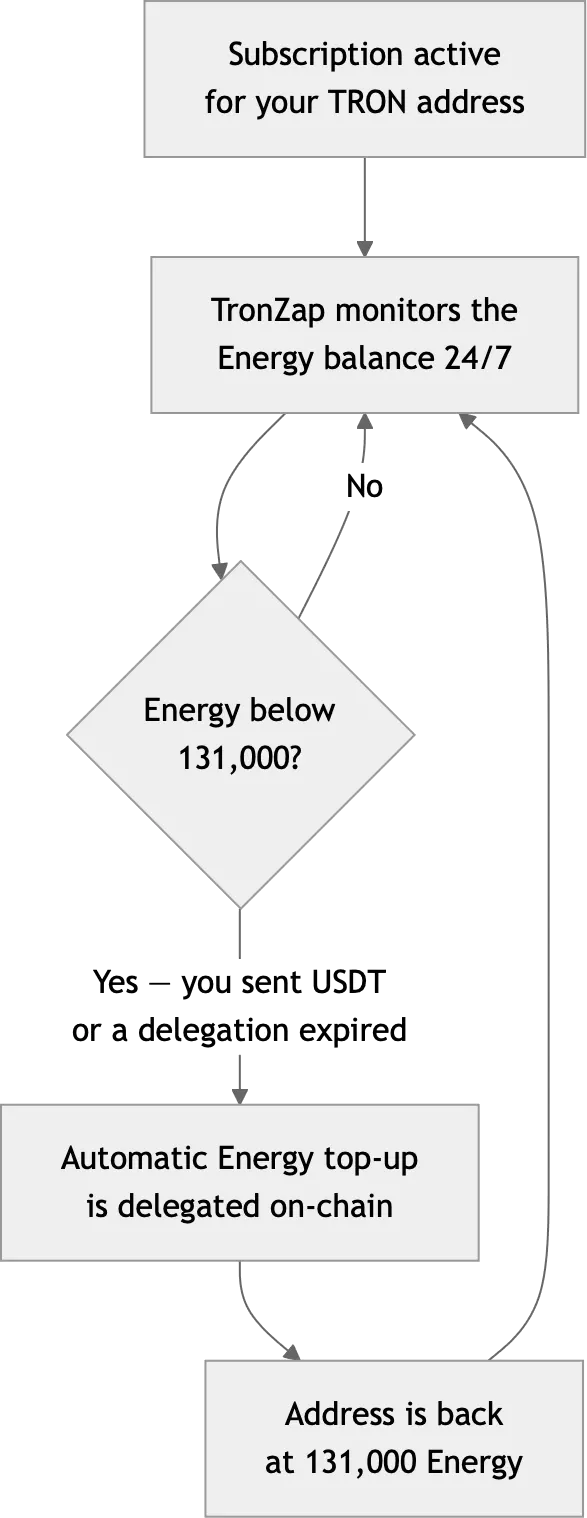
From your side, the experience is boring in the best way: the wallet just always has Energy. You open TronLink, send USDT, and it goes through with zero TRX burned. Every time.
Why 131,000 and not 65,000?
Because 65,000 only covers the happy path. The moment someone gives you a fresh deposit address — an exchange sub-account, a new customer wallet, a friend's first-ever USDT — the cost doubles, and a wallet holding exactly 65,000 Energy fails. Keeping the balance at 131,000 removes the guesswork:
| Your next transfer goes to… | Energy needed | Covered at 131,000? |
|---|---|---|
| An address that already holds USDT | ~65,000 | Yes — with a full second transfer to spare |
| An address that never held USDT | ~131,000 | Yes — exactly covered |
In other words, 131,000 is the "any recipient, any time" threshold. It's the same number TronZap recommends to anyone buying Energy manually before an important transfer — the subscription just maintains it for you permanently.
Three ways to turn the subscription on
1. Through the TronZap Telegram bot
The fastest route for individual users. Open @tronzap_bot, top up your balance with TRX, choose the subscription option, and paste the TRON address you want covered. From that moment the address is monitored and topped up automatically. Managing it — checking status, pausing, canceling — happens in the same chat.
2. Through your TronZap dashboard
Create a free account and open the personal dashboard. There you can enable subscriptions for one or several addresses, see every automatic top-up in the transaction history, keep an eye on your balance, and manage everything from one screen. This is the natural home for merchants and small teams: all working wallets, all activity, one page.
3. Through the TronZap API
For payment providers, exchangers, and platforms managing dozens or hundreds of wallets, subscriptions are fully controllable over the TronZap Energy API. The relevant endpoints:
| Endpoint | What it does |
|---|---|
POST /v1/subscriptions |
List available subscription plans |
POST /v1/subscription/start |
Start a subscription for an address |
POST /v1/subscription/check |
Get the current status of a subscription |
POST /v1/subscription/stop |
Stop a subscription |
POST /v1/subscriptions/history |
Pull your full subscription history |
That means onboarding a new payout wallet can be one API call in your own backend: create the wallet, start the subscription, done. Official SDKs for PHP, Node.js, and Python wrap these endpoints, so there's no need to hand-roll authentication or signatures.
Cancel anytime — really
The subscription has no minimum term, no lock-in, and no cancellation fee. Stop it in the bot, in the dashboard, or with a single subscription/stop API call, and the monitoring ends immediately. Any Energy already delegated to your address stays there until its delegation window runs out. If your transfer volume is seasonal — busy months, quiet months — you can switch the subscription off and on as often as you like. There are no obligations attached to it.
Who gets the most out of it
- Active personal users. If you send USDT more than a few times a week, the subscription removes the pre-flight ritual of checking balances and buying Energy. You just send.
- Online shops and freelancers accepting USDT. Refunds, supplier payments, and withdrawals go out the moment you need them — no failed transactions in front of a client.
- Payment service providers and exchangers. Payout wallets that must work at any hour are the textbook case. A subscribed wallet cannot hit OUT_OF_ENERGY, which means fewer stuck payouts, fewer support tickets, and no TRX silently burning on retries.
- Bots and automated services. Anything that sends USDT programmatically benefits from an Energy supply that's just as programmatic.
What it saves you
Compare the two ways a busy wallet can pay for, say, 100 USDT transfers a month:
| Approach | What happens | Rough monthly cost in TRX |
|---|---|---|
| No Energy — burn TRX | ~6.5–13 TRX burned per transfer | 650–1,300 TRX |
| TronZap subscription | Energy auto-delivered at rental rates, a fraction of the burn price | Several times less — plus zero failed transfers |
The exact rental pricing moves with the market — current rates are always visible on tronzap.com — but the relationship holds: delegated Energy consistently costs a fraction of what burning TRX does. The subscription simply applies that saving to every single transfer without you lifting a finger, and adds reliability on top.
The bottom line
A TRON Energy subscription turns Energy from something you manage into something that's simply there. TronZap monitors your address 24/7, keeps it at 131,000 Energy — enough for a USDT transfer to anyone — and refills it the instant it dips. Switch it on in the Telegram bot, in your dashboard, or via the API, and switch it off whenever you like. No commitments, no burned TRX, no failed transfers.
Frequently asked questions
Does TronZap need access to my wallet?
No. A subscription only needs your public TRON address — the one starting with T. Energy delegation is an on-chain operation performed to your address. Your keys and funds are never involved.
What if I send several transfers back to back?
The monitor reacts as soon as the balance drops below 131,000, so the address is refilled between transfers. For sustained high-frequency flows, the API lets you combine the subscription with on-demand purchases sized to your exact throughput.
Can I subscribe someone else's address?
Yes. You can point a subscription at any TRON address you want kept topped up — your own wallets, a team wallet, or a family member's.
Authors
Written by: Marc Wei - Blockchain Payments Engineer
Reviewed by: Aren Skovarr - TRON Architect, Researcher and CEX Strategist
Marc and Aren live and breathe the TRON ecosystem. They audit smart contracts, design staking and resource strategies, and put TRON energy to work across real business cases - payments, exchanges, iGaming.
As advisors at TronZap, they help users and businesses move digital assets the smart way.
Back