This is a real TronZap integration. At the partner's request, the company's actual name has been replaced with "AB Exchange" throughout this article. The workflow, the resource math, and the integration details are described as they work in production.
Most cryptocurrency exchanges live and die by two numbers: the spread they quote and the costs they eat.
AB Exchange, a mid-size crypto exchange service, quotes fiat-to-USDT and crypto-to-USDT deals all day long. Every completed deal ends the same way: a TRC20 USDT payout leaves one of their hot wallets on TRON.
Multiply that by hundreds of payouts a day, and TRON's resource model turns from a technical footnote into a line on the P&L. Below is the before, the after, and the parts worth stealing.
Before: every payout paid full price
AB Exchange runs a handful of payout hot wallets and processes roughly 300 USDT payouts on a typical day, about 9,000 a month. Before the integration, those wallets held no Energy at all, so the network charged every payout the expensive way, by burning TRX at the current rate of 100 sun per Energy unit:
- A payout to a client whose wallet already held USDT consumed ~65,000 Energy — about 7 TRX burned.
- A payout to a wallet that had never held USDT consumed ~131,000 Energy — about 14 TRX burned. And this is the exchanger's curse: a large share of clients arrive with fresh wallets, so the double-cost case fires constantly.
- After the first payout of the day, each wallet's 600 free Bandwidth points were spent too (a USDT transfer takes ~345), so every following payout burned another ~0.35 TRX for Bandwidth.
With roughly 40% of payouts going to first-time USDT holders, the blended burn worked out to about 9 TRX per payout. The monthly arithmetic, at a TRX price of $0.30 for illustration:
| Per payout | Per month (~9,000 payouts) | |
|---|---|---|
| Energy paid by burning TRX | ~9 TRX blended | ~81,000 TRX ≈ $24,300 |
| Bandwidth overflow | ~0.35 TRX | ~3,000 TRX ≈ $900 |
| Total destroyed | ~9.3 TRX | ~84,000 TRX ≈ $25,200 |
Worse than the number itself was its behavior. The burn scaled with TRX price, spiked when fresh-wallet clients clustered, and occasionally flipped into outright failure: a wallet that ran out of both Energy and TRX at 3 a.m. produced an OUT_OF_ENERGY error, a stuck payout, and an angry client in the morning. The night shift picked up a duty nobody signed up for: babysitting TRX balances.
The fix, in three pieces
AB Exchange didn't rebuild anything. The payout pipeline stayed as it was, and TronZap slotted in around it:
1. Energy subscriptions on every payout wallet
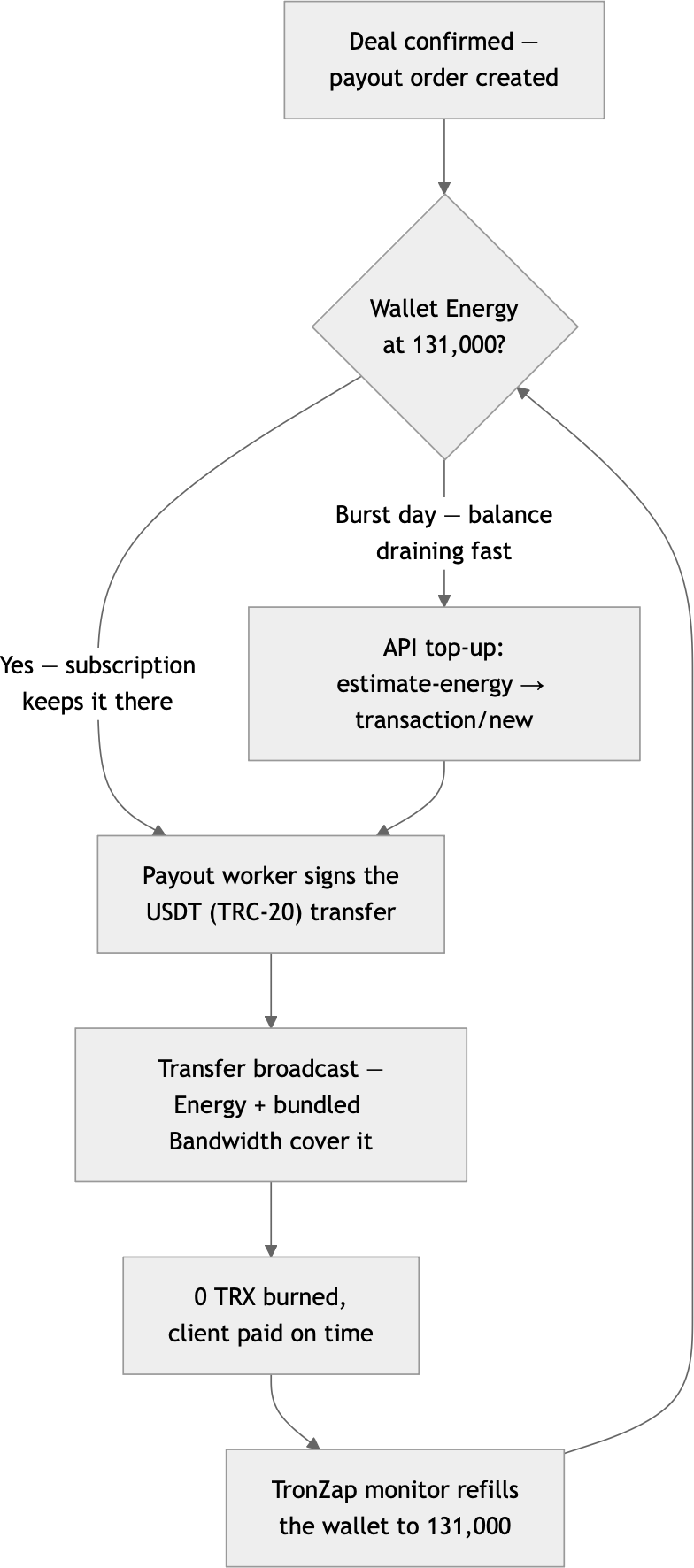
Each hot wallet went onto a TRON Energy subscription. TronZap now monitors those addresses around the clock and automatically tops each one back up to 131,000 Energy the moment a payout drains it. The 131,000 target is exactly why this works for an exchanger: it covers a transfer to any recipient, fresh wallet or not, so the operator never has to know or care whether the next client is new to USDT. Turning the subscriptions on took a few clicks in the dashboard. Turning them off, when a quiet season comes, takes the same — no lock-in was a condition here, not a nice-to-have.
2. API top-ups for volume spikes
On heavy days, payouts can leave a wallet faster than a single refill cycle. For those bursts, AB Exchange wired the TronZap Energy API into its payout worker: before broadcasting a large batch, the worker calls POST /v1/estimate-energy for the exact requirement (the endpoint checks each recipient's USDT history), then POST /v1/transaction/new to stack additional Energy on the wallet, confirmed via POST /v1/transaction/check. The Node.js SDK handled authentication out of the box, so the whole branch was a day of work.
3. Bandwidth bundles for busy wallets
A payout wallet firing dozens of transfers a day blows through its 600 free daily Bandwidth points before breakfast. Rather than letting the network shave ~0.35 TRX off every subsequent payout, AB Exchange covers the gap with TronZap's Energy + Bandwidth bundles: one purchase, both resources, sized for a day's throughput. This is the piece low-volume users never notice and high-volume senders can't skip.
One more thing came free with the account: AML checks through the same TronZap API. Incoming client addresses are now screened in the same pipeline that manages resources, a tidy bonus for a business that answers to compliance questionnaires.
The new payout flow
What changed in the numbers
Rented Energy costs a fraction of what burning does. That is the whole business case of delegation, and at exchanger volume it compounds fast. Set against the ~$25,000 monthly burn in the table above, the setup pays for itself many times over each month (current rental rates are always visible on tronzap.com). The money, though, is only half of it:
- Zero OUT_OF_ENERGY incidents since the subscriptions went live. A wallet pinned at 131,000 Energy cannot fail a payout for lack of resources.
- Predictable unit economics. The cost of a payout no longer depends on whether the client's wallet is fresh — the subscription absorbs the 65k/131k lottery, so the quoted spread doesn't have to hedge it.
- Ops time back. Nobody tops up TRX balances by hand anymore, and the dashboard shows every automatic delegation in one history.
Steal this checklist
- Put every payout hot wallet on a TronZap subscription — the 131,000 target exists precisely for businesses that pay out to strangers' wallets.
- If your daily volume can outrun a refill, add the API branch:
estimate-energy→transaction/new→transaction/checkbefore big batches. SDKs are available for PHP, Node.js, and Python. - Count your Bandwidth. More than one payout per wallet per day means the free 600 points won't stretch — take Energy + Bandwidth bundles instead of burning ~0.35 TRX per transfer for nothing.
- Screen incoming addresses with the AML endpoints on the same account — one integration, two problems solved.
- Keep a small TRX float anyway. Resources cover the fees, but a buffer is cheap insurance for edge cases.
Frequently asked questions
Why keep 131,000 Energy and not just 65,000?
Because an exchanger doesn't choose its recipients. Any given payout can go to a wallet that has never held USDT, and that transfer needs ~131,000 Energy instead of ~65,000. A wallet pinned at the higher figure covers every payout unconditionally — which is the whole point of a subscription: removing the case-by-case guesswork.
Does AB Exchange still hold TRX on the payout wallets?
A small float, yes — as insurance, not as fuel. With TRON Energy and Bandwidth supplied by TronZap, the network deducts nothing from it in normal operation. The float exists for edge cases and the occasional plain TRX transfer.
What happens when the TRX price rallies?
Before the integration, a rally silently repriced every payout — burn costs are denominated in TRX, so the dollar bill grew with the chart. Rented Energy keeps the unit cost at rental rates instead, so AB Exchange's quoted spreads no longer carry a hidden hedge against fee volatility.
The bottom line
AB Exchange didn't change its business. Same wallets, same payout worker, same clients.
What changed is where the TRON fees go: instead of burning TRX at the network's list price on every payout, the exchanger now sources Energy and Bandwidth from TronZap at rental rates, automatically, around the clock.
For any exchange service still paying the burn, the same three blocks — TRX Energy subscriptions, API top-ups, bundles — are three links away in the TRON Energy API documentation.
Authors
Written by: Marc Wei — Blockchain Payments Engineer
Reviewed by: Aren Skovarr — TRON Architect, Researcher and CEX Strategist
Marc and Aren live and breathe the TRON ecosystem. They audit smart contracts, design staking and resource strategies, and put TRON energy to work across real business cases — payments, exchanges, iGaming.
As advisors at TronZap, they help users and businesses move digital assets the smart way.
Back