If you have ever sent USDT on the TRON network and watched a few TRX quietly disappear from your wallet, you have already met TRON Energy — you just didn't see it. Energy is the invisible fuel behind every USDT (TRC-20) transfer, every swap, and every smart contract call on TRON. When you have it, transfers cost you nothing extra. When you don't, the network burns your TRX to cover the gap.
This guide breaks down what TRON Energy is, where it comes from, how it gets spent, and what your options are when you need more of it. No jargon, no fluff — just the mechanics, with real numbers.
TRON doesn't have gas fees. It has resources
Most blockchains charge a gas fee for every transaction. TRON works differently. Instead of one fee, every TRON account works with two renewable resources:
- Bandwidth — pays for the size of a transaction in bytes. Think of it as the cost of writing data to the blockchain. Every activated account gets 600 free Bandwidth points per day, refreshed automatically.
- Energy — pays for computation. Whenever a transaction runs smart contract code, the TRON Virtual Machine meters every step of that code and charges Energy for it. There is no free daily Energy. You either produce it by staking TRX, rent it, or the network burns your TRX instead.
Here's the difference at a glance:
| Bandwidth | Energy | |
|---|---|---|
| What it pays for | Transaction data (bytes) | Smart contract execution |
| Free daily amount | 600 points per account | 0 — none |
| Used by | Every transaction | Only smart contract calls (USDT, swaps, dApps) |
| Typical cost of a plain TRX transfer | ~268 points | 0 |
| Typical cost of a USDT transfer | ~345 points | ~65,000 units |
| If you run out | TRX burned (0.001 TRX per point) | TRX burned (100 sun per unit) |
Notice the key detail: sending TRX itself doesn't touch Energy at all. TRX is the native coin, and moving it is a simple ledger operation. USDT is different — it's a token that lives inside a smart contract, so every USDT transfer is actually a call to that contract's code. And code costs Energy.
Where TRON Energy comes from: staking TRX
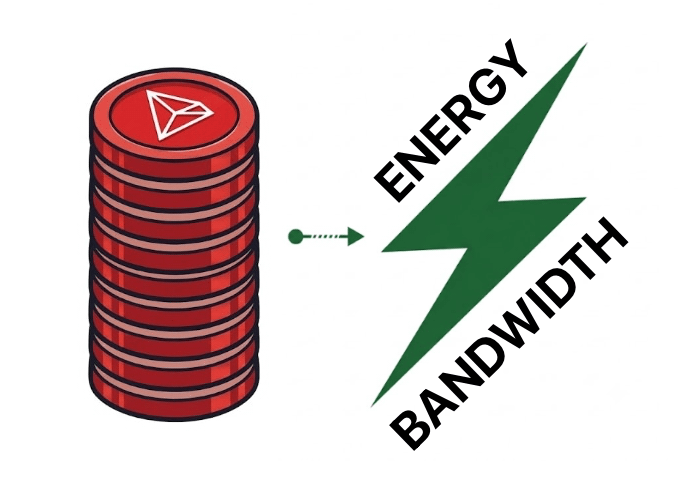
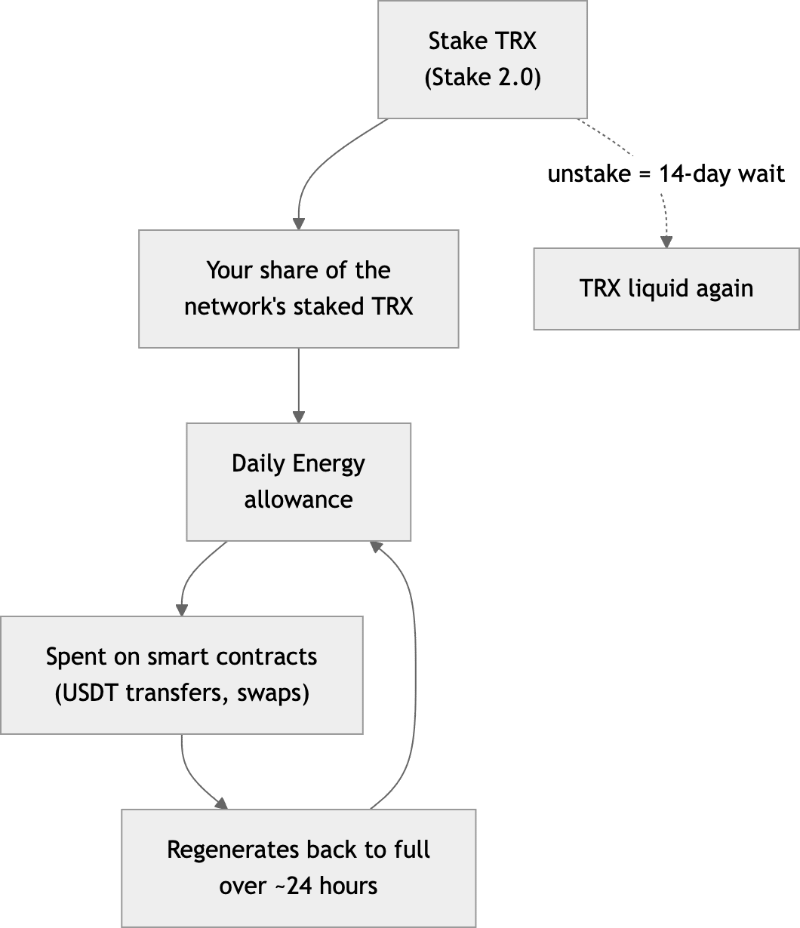
Energy is created in exactly one place — by staking (freezing) TRX under TRON's Stake 2.0 system. When you stake TRX and choose "Energy" as the resource, the network grants you a daily Energy allowance proportional to your share of all TRX staked for Energy across the entire network.
Three things are worth knowing about how staking works:
- Your allowance is a share, not a fixed rate. The network distributes a fixed daily pool — 180 billion Energy — among all stakers. If more people stake, each staked TRX yields slightly less Energy, and vice versa.
- Energy regenerates over 24 hours. When you spend Energy, it doesn't come back instantly. It recovers gradually and returns to full over roughly a day.
- Unstaking takes 14 days. Once you decide to unfreeze your TRX, you wait two weeks before the coins are liquid again. Staking is a real commitment, not a toggle.
Here's the full staking cycle:
How much do you need to stake? As of mid-2026, covering the Energy for just one standard USDT transfer per day takes roughly 5,000 staked TRX. The exact figure floats with the total network stake, but the order of magnitude is the point: staking only makes sense if you send a lot of transfers and can afford to lock up serious capital. For everyone else, there are cheaper ways to get Energy — more on that below.
How Energy and Bandwidth actually get spent
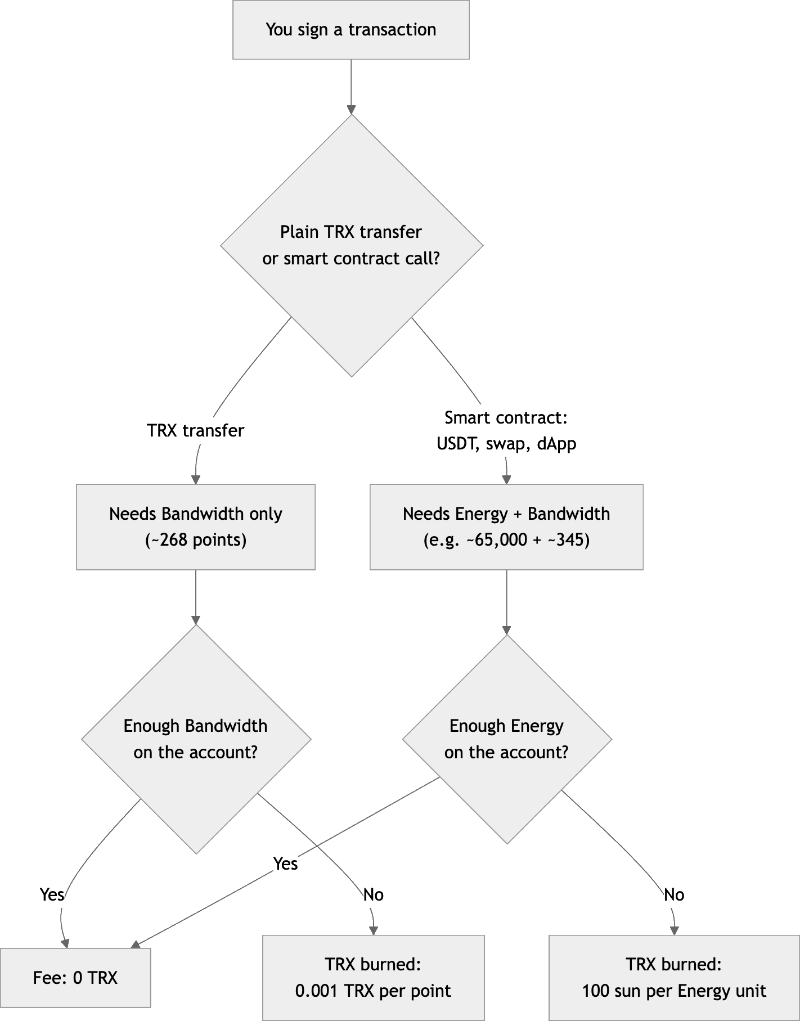
Every time you sign a transaction, TRON decides which resources it needs and checks whether your account has them.
The logic looks like this:
Let's put real numbers on the most common case — a USDT (TRC-20) transfer:
| Operation | Energy needed | Bandwidth needed |
|---|---|---|
| Send TRX | 0 | ~268 |
| Send USDT to an address that already holds USDT | ~65,000 | ~345 |
| Send USDT to an address that has never held USDT | ~131,000 | ~345 |
Two details here surprise almost everyone:
- The amount doesn't matter. Sending 1 USDT costs exactly the same Energy as sending 100,000 USDT. The contract does the same work either way.
- The recipient matters a lot. If the destination address has never held USDT, the contract has to create a brand-new storage record for it — and writing new data is expensive. That's why the Energy requirement roughly doubles, from ~65,000 to ~131,000 units. Before sending to an unfamiliar address, it's worth checking its status with the free Estimate Energy tool on TronZap, so you know the real cost in advance.
What happens when you run out: burning TRX
TRON never rejects your transaction just because you have zero Energy — as long as you hold TRX. Instead, it falls back to burning. The network calculates the Energy shortfall, converts it to TRX at the current on-chain price, and destroys that TRX from your balance.
Since August 2025, when TRON's community vote (Proposal #104) cut the Energy unit price from 210 to 100 sun, the burn math looks like this (1 sun = 0.000001 TRX):
- Standard USDT transfer with zero Energy: 65,000 × 100 sun ≈ 6.5 TRX burned
- USDT transfer to a fresh recipient with zero Energy: 131,000 × 100 sun ≈ 13 TRX burned
- Out of Bandwidth too? Add about 0.35 TRX for the transaction bytes.
Burning feels convenient because it's automatic — the network just takes the fee and moves on. But it's consistently the most expensive way to pay. And if your wallet has neither Energy nor enough TRX to burn, the transfer fails outright, usually with the infamous OUT_OF_ENERGY error in TronLink and other wallets.
Three ways to cover your Energy needs
| Method | Upfront cost | Cost per USDT transfer | Best for |
|---|---|---|---|
| Burn TRX (do nothing) | None | ~6.5–13 TRX | Someone who sends USDT once or twice a year |
| Stake TRX yourself | ~5,000 TRX locked per daily transfer, 14-day unstake | 0 TRX ongoing | Very high, constant volume with capital to spare |
| Rent Energy on TronZap | None — pay per use | A fraction of the burn price | Everyone in between: regular users, shops, services |
Renting is the middle path that fits most people. TronZap maintains a large pool of staked TRX and delegates Energy from it to your wallet on demand. You pay a small amount of TRX, the Energy lands in your wallet within a minute, and your next USDT transfer spends the delegated Energy instead of burning TRX. The delegation is fully on-chain and non-custodial — the service only ever needs your public address, never your keys.
The bottom line
TRON Energy is simply the network's way of charging for computation. Plain TRX transfers don't need it, anything involving a smart contract — starting with every USDT (TRC-20) transfer — does.
You can pay for Energy the expensive way (burning TRX), the capital-heavy way (staking thousands of TRX), or the practical way: renting exactly the amount you need, exactly when you need it.
For the third option, TronZap delegates Energy to any TRON wallet in a few seconds — through the website, the Telegram bot, or the API.
Frequently asked questions
Is TRON Energy a token I can trade?
No. Energy is not a coin and has no ticker. It's an internal account resource that only exists on your TRON address. You can't send it to an exchange, but a staker can delegate it to another address — which is exactly how Energy rental works.
Do I need TRX in my wallet if I have Energy?
For a USDT transfer — not necessarily. If your account holds enough Energy and Bandwidth to cover the transaction, no TRX is deducted at all. That's how services process thousands of USDT payouts from wallets holding zero TRX.
Does unused rented Energy carry over?
Rented Energy is delegated for a fixed window — for example 1 hour. Use it within that window, afterwards the delegation returns to the pool.
Authors
Written by: Marc Wei — Blockchain Payments Engineer
Reviewed by: Aren Skovarr — TRON Architect, Researcher and CEX Strategist
Marc and Aren live and breathe the TRON ecosystem. They audit smart contracts, design staking and resource strategies, and put TRON energy to work across real business cases — payments, exchanges, iGaming.
As advisors at TronZap, they help users and businesses move digital assets the smart way.
Back