Check any active TRON wallet on TronScan and you'll find the same quiet leak: a few TRX gone here, thirteen TRX gone there, all labeled "burned for Energy".
Nobody chose to pay those fees. They happen automatically, every time a wallet interacts with a smart contract without enough resources on board. Over a year of regular USDT transfers, the leak adds up to real money.
This guide explains exactly why TRX gets burned, walks through the numbers for the two most common cases — a plain USDT transfer and a heavier contract interaction like a swap — and lays out the practical ways to cut the burn to zero.
Why TRX gets burned at all
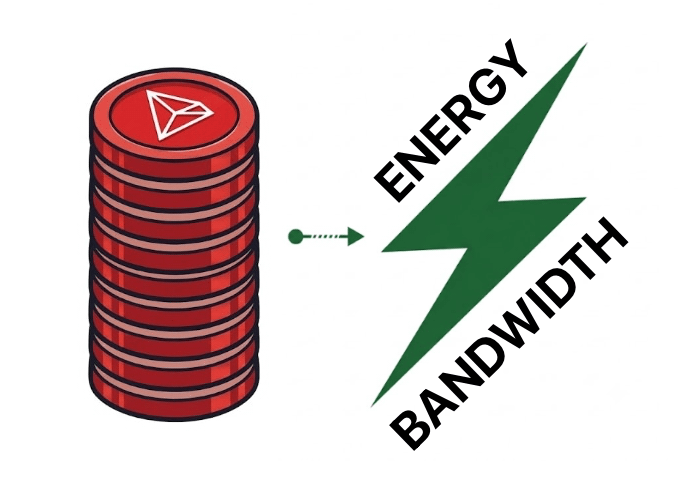
TRON has no flat gas fee. Instead, every transaction consumes two account resources:
- Bandwidth — pays for the transaction's size in bytes. Each account gets 600 free points daily. A plain TRX transfer takes ~268, a USDT transfer ~345.
- Energy — pays for smart contract computation, opcode by opcode. There is no free Energy. You get it by staking TRX, by having it delegated to you (that's what Energy rental is), or not at all.
Here's the key rule: every smart contract on TRON eats Energy and Bandwidth, and when your account doesn't have them, the network burns your TRX to cover the difference. The burn isn't a penalty or a bug — it's the built-in fallback. Energy converts to TRX at 100 sun per unit (1 sun = 0.000001 TRX), Bandwidth at 1,000 sun per point.
The payment waterfall looks like this:
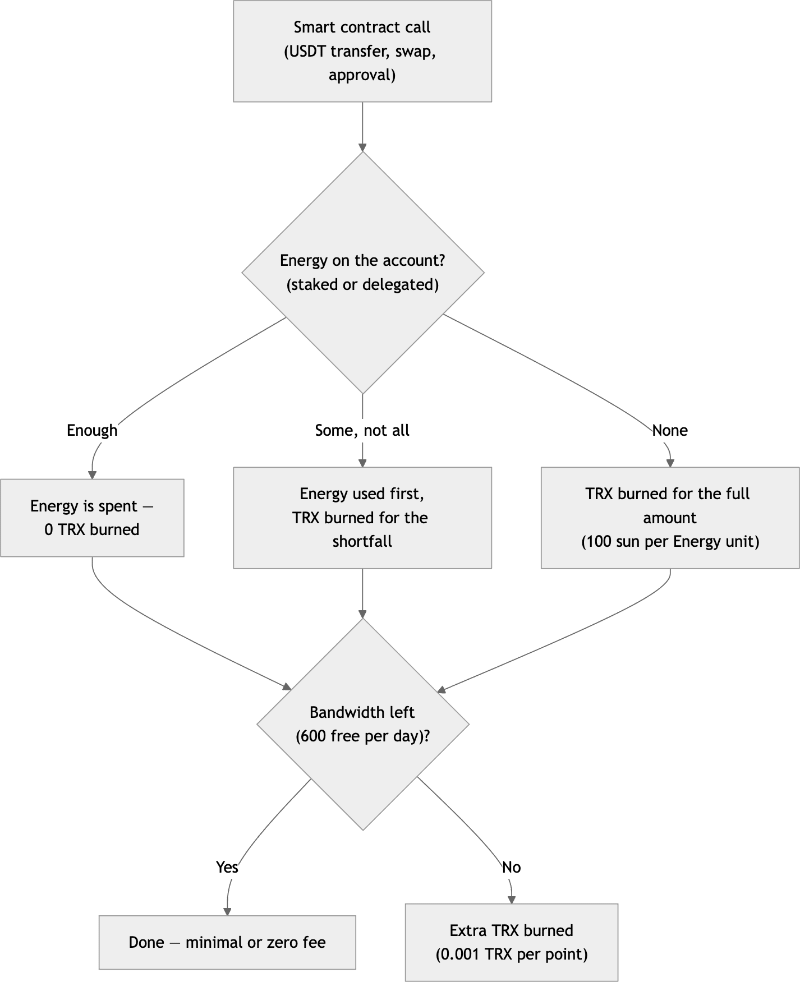
TRX itself is the exception. Sending TRX is a native operation, not a contract call — it uses only Bandwidth, and your free daily allowance usually covers it. The moment tokens or dApps enter the picture, Energy takes over as the real cost.
Case study 1: the USDT contract
USDT on TRON is a TRC-20 token living inside a smart contract (address TR7NHqjeKQxGTCi8q8ZY4pL8otSzgjLj6t). When you "send USDT", your wallet actually calls that contract's transfer() function. The TRON Virtual Machine executes it — check balances, subtract from you, add to the recipient, log the event — and bills Energy for every step:
| Transfer type | Energy | Bandwidth | TRX burned with empty resources |
|---|---|---|---|
| USDT to an address that already holds USDT | ~65,000 | ~345 | ~6.5 TRX + ~0.35 TRX |
| USDT to an address that has never held USDT | ~131,000 | ~345 | ~13 TRX + ~0.35 TRX |
Two things about this table trip people up. First, the transfer amount is irrelevant — moving 1 USDT and 100,000 USDT costs identical Energy, because the contract runs the same code either way. Second, the recipient doubles the bill: writing a brand-new storage record for a first-time USDT holder is the single most expensive step the contract can take. If you often pay out to fresh addresses, budget for 131,000 Energy, not 65,000.
Case study 2: Swaps and USDT0 — where the numbers get big
A simple token transfer is the cheapest contract interaction on TRON. Anything more ambitious calls a chain of contracts, and the Energy bill grows with every link.
Take a DEX swap on SunSwap: one trade typically involves a token approval plus the swap routing itself — several contract calls back to back. Or take moving your TRC-20 USDT into the USDT0 ecosystem. USDT0 is Tether's omnichain version of USDT, and its Legacy Mesh connects TRON's native USDT to chains like Arbitrum and Ethereum. Kicking that off from TRON means interacting with the mesh's liquidity contracts on the TRON side — an approval, a deposit call, cross-chain messaging fees — which is far heavier computation than a plain transfer().
| Operation | Typical Energy | What burns if you're empty |
|---|---|---|
| Plain TRX transfer | 0 | ~0.27 TRX at most (Bandwidth) |
| USDT transfer | ~65,000–131,000 | ~6.5–13 TRX |
| Token approval | tens of thousands | several TRX |
| DEX swap / USDT0 bridge deposit | ~150,000–500,000+ across the calls | ~15–50+ TRX |
The exact figures for complex operations vary with the route, the contracts involved, and TRON's dynamic Energy model, which can raise consumption for busy contracts during peak load. That's exactly why guessing is a bad strategy: before any heavy interaction, run the numbers with the Estimate Energy tool on TronZap, then rent precisely what the operation needs. Burning 40 TRX on a swap because the wallet was empty is the kind of fee you only pay once — after that, you rent.
Five ways to stop the burn
1. Buy the Energy before you press Send
This is the whole game. Delegated Energy from TronZap costs a fraction of the burn price for the same transfer, arrives in your wallet within a minute, and requires nothing but your public address. Use the Telegram bot for a few taps on mobile, or the quick rental address on the website with no account at all. Rent 65,000+ for a known recipient, 131,000+ to be safe with anyone.
2. Check the recipient before large payouts
Since a first-time USDT holder doubles your Energy cost, it pays to know in advance. TronZap's Estimate Energy does this check for you and returns the exact requirement for your specific from-and-to pair.
3. Cover Bandwidth too — or grab a bundle
A transfer with plenty of Energy can still nibble TRX if the day's free 600 Bandwidth points are spent. TronZap rents Bandwidth as well, and its Energy + Bandwidth bundles cover both resources in one purchase — useful for wallets that fire several transactions a day.
4. Turn on a subscription for wallets that send regularly
If a wallet sends USDT daily, manual buying becomes the bottleneck. A TronZap subscription monitors the address 24/7 and automatically keeps it at 131,000 Energy, so every transfer — to anyone — goes out with zero burn. It's switchable on and off anytime in the bot, the dashboard, or over the API.
5. Stake only if your volume truly justifies it
Staking TRX generates Energy daily, but covering even one USDT transfer per day takes roughly 5,000 staked TRX at mid-2026 network conditions, with a 14-day unstaking lock. For exchanges moving thousands of transfers it can pencil out. For almost everyone else, renting wins on both cost and flexibility.
A 20-second checklist before you hit Send
- Does the wallet hold at least 65,000 Energy — or 131,000 if the recipient might be new to USDT?
- Any free Bandwidth left today, or should the purchase include it?
- Is this a plain transfer or a contract-heavy operation (swap, bridge, USDT0)? If heavy — estimate first, rent second.
- Sending several payments? Don't split what can go as one transfer — Energy cost doesn't scale with amount.
Frequently asked questions
Can burned TRX be recovered?
No. Burning permanently destroys the coins — they leave circulation entirely and don't go to a validator or a fee pool. The same applies to failed transactions: an OUT_OF_ENERGY failure deducts the transaction's full Energy allowance up to the fee limit, with no refund — one more reason to load Energy before sending rather than gambling on the fallback.
I had some Energy — why did the transfer still burn TRX?
Partial coverage. The network always spends your available Energy first and burns TRX only for the shortfall. A wallet holding 40,000 Energy that sends a 65,000-Energy transfer will burn TRX worth the missing 25,000 units. Keep the full amount on the account and the burn line disappears completely.
Does receiving USDT cost me anything?
No. All resources — Energy and Bandwidth — are charged to the sender. The recipient pays nothing, even on their very first USDT. The doubled cost for fresh recipients also lands on the sender's side.
The bottom line
TRX burning is just TRON charging you list price for resources you could have sourced cheaper. Every smart contract — from the USDT token itself to SunSwap and the USDT0 Legacy Mesh — consumes Energy and Bandwidth, and an empty wallet pays for them in burned TRX at the worst possible rate. Load the resources first instead: rent TRX Energy and Bandwidth, or put busy wallets on a subscription. Same transfers, same speed — minus the leak.
Authors
Written by: Marc Wei — Blockchain Payments Engineer
Reviewed by: Aren Skovarr — TRON Architect, Researcher and CEX Strategist
Marc and Aren live and breathe the TRON ecosystem. They audit smart contracts, design staking and resource strategies, and put TRON energy to work across real business cases — payments, exchanges, iGaming.
As advisors at TronZap, they help users and businesses move digital assets the smart way.
Back