This is a real TronZap integration. At the partner's request, the company's actual name has been replaced with "PAYLINE PSP" throughout this article. The workflow, the resource math, and the integration details are described as they work in production.
PAYLINE PSP is a licensed crypto payment provider: it holds a crypto (VASP-type) license, accepts coin payments on behalf of online merchants, and settles them in stablecoins.
Like most processors, its bread and butter on TRON is TRC20 USDT, and its architecture is the standard one: a unique deposit address per invoice.
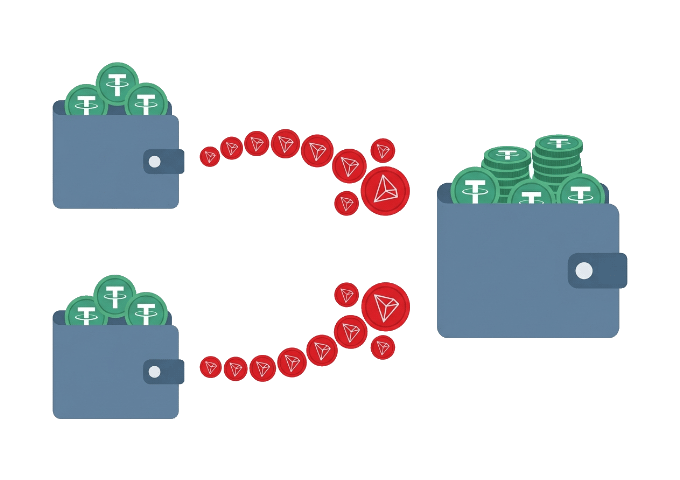
A customer pays the invoice, the funds land on that one-off address, and then comes the part every PSP knows too well: the sweep, consolidating the USDT from the invoice address into the company treasury.
That single step, repeated thousands of times a month, is where TRON fees either bleed you or don't. Here's how PAYLINE PSP made them not.
The anatomy of a USDT sweep on TRON — and why it costs money
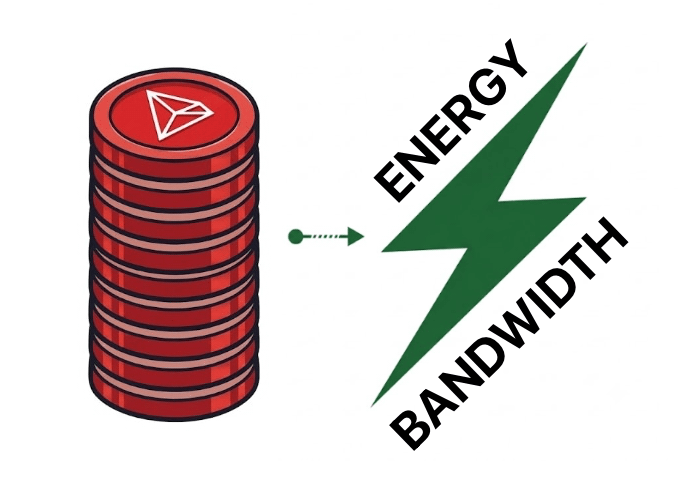
A sweep is just a USDT transfer: the invoice address calls the USDT smart contract and sends the balance to the treasury wallet. On TRON, that contract call consumes two resources:
- Energy: ~65,000 units. For a PSP this is always the cheap case. The destination is the company's own treasury, which already holds USDT, so the doubled 131,000 "first-time recipient" cost physically can't occur in a sweep.
- Bandwidth: ~345 points for the transaction bytes.
Before the TronZap integration, PAYLINE's invoice addresses held no Energy, so the network burned TRX from the small float the sweeper deposited onto each address: about 7 TRX per sweep at the current 100-sun Energy price. And before that fee even hits, someone has to put TRX onto thousands of throwaway addresses in the first place — a chore with its own payroll cost. At PAYLINE's volume of roughly 60,000 paid invoices a month, the arithmetic looked like this (TRX at $0.30 for illustration):
| Per sweep | Per month (~60,000 sweeps) | Per year | |
|---|---|---|---|
| Energy paid by burning TRX | ~7 TRX | ~420,000 TRX ≈$126,000 | ≈$1,512,000 |
| Same Energy rented from TronZap | a fraction of the burn price | several times less | several times less |
The gap between those two rows is measured in tens of thousands of dollars a month at this volume — money that was being destroyed on-chain, not paid to anyone. That's the entire case study in one table. The rest is how the integration actually works, including one detail that surprises most teams.
Sweeps don't need Bandwidth rental. At all.
This is where the invoice-address pattern pays you back. Every activated TRON account receives 600 free Bandwidth points per day, and a USDT transfer consumes about 345. An invoice address sweeps once — one outgoing transaction in its entire life. One transaction, 345 points, 600 free: the daily allowance covers it with room to spare.
So unlike an exchanger's hot wallet, which fires dozens of transfers a day from one address and must budget for Bandwidth, a PSP sweeping one-off invoice addresses needs to rent Energy only. No Bandwidth purchases, no bundles: the free allowance does the job on every single sweep. PAYLINE's per-sweep shopping list is exactly one line: 65,000 Energy, one-hour delegation.
One caveat belongs here, because it bites teams that skip it: a TRON address that has only ever received TRC-20 tokens may not be activated on-chain yet, and an unactivated account can't initiate the sweep (and doesn't get the free Bandwidth either). PAYLINE handles this inside the same TronZap call — the transaction/new endpoint takes an activate_address flag, so activation and Energy delegation arrive together when a fresh invoice address needs both.
The pipeline, end to end
PAYLINE wired the TronZap Energy API into its existing sweeper.
The whole flow is four calls and a broadcast:
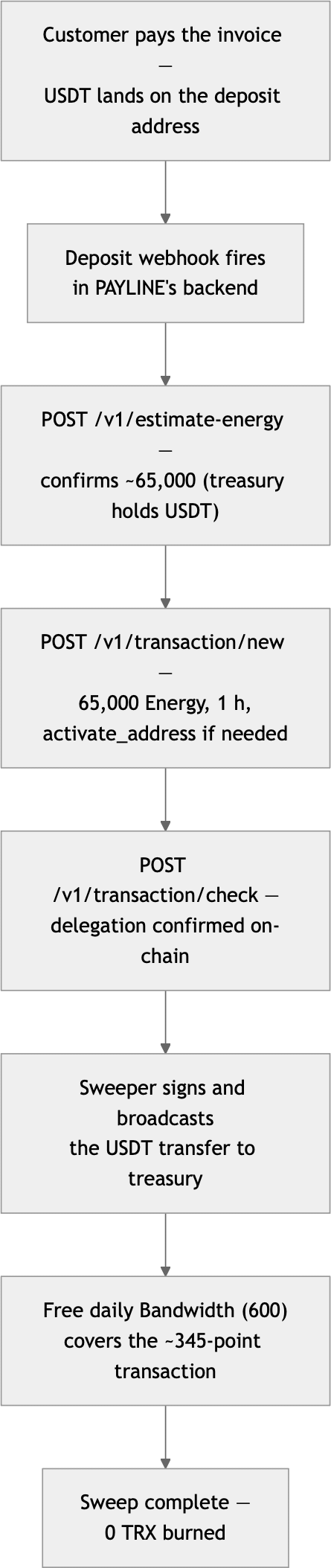
A few production notes from the integration:
- Estimate first, buy second.
estimate-energyaccounts for TRON's dynamic Energy model, so on days when the USDT contract carries a surcharge, the purchase is sized to reality instead of to a hardcoded 65,000. - One-hour delegations fit sweeps perfectly. The sweep broadcasts seconds after the Energy lands, so there's no reason to pay for a 24-hour window.
- The PHP SDK carried the whole thing. Authentication (Bearer token + SHA-256 signatures), retries, and error handling came from
tron-energy-market/tronzap-sdk-php. The sweeper gained about a hundred lines of code. - Batching still matters. Energy cost doesn't depend on the USDT amount, so PAYLINE sweeps the full invoice balance in one transfer — never in parts.
The compliance angle
A licensed PSP doesn't just move money — it has to screen it. PAYLINE runs AML checks on incoming payments through the same TronZap account: the /v1/aml-checks/new endpoint screens the payer's address or the deposit transaction hash before the sweep is queued, and risky payments are routed to manual review instead of the treasury. One API key now covers both the resource layer and a screening layer, which shortened the vendor list the compliance team maintains.
What the treasury sees now
- The TRX burn line went to zero on sweep operations — every sweep runs on rented Energy and free Bandwidth.
- No more TRX logistics. Invoice addresses no longer need TRX floats deposited and reconciled. Activation, when needed, rides along with the Energy purchase.
- Costs became linear and forecastable. One sweep = one known rental fee, regardless of TRX price swings or how "fresh" the address is.
- Savings in five figures monthly at 60,000 sweeps, against the ~$126,000 the burn was consuming — with the exact figure moving with volume, TRX price, and current rental rates on tronzap.com.
Copy this setup
If you run per-invoice deposit addresses on TRON, your version of this is short:
- Register on tronzap.com and generate API keys in the dashboard.
- On each deposit webhook:
estimate-energy→transaction/new(withactivate_addressfor fresh addresses) →transaction/check→ broadcast the sweep. - Skip Bandwidth entirely — the 600 free daily points cover a one-time sweep's ~345.
- Grab the SDK for your stack (PHP, Node.js, or Python) and the Energy API Reference — the endpoints above are all of it.
- Optional but sensible for licensed operators: add the AML endpoints to the same pipeline.
Frequently asked questions
Is it really always 65,000 Energy — never 131,000?
For sweeps, yes, with one one-time exception: the very first inbound transfer to a brand-new treasury wallet that has never held USDT costs the doubled amount. After that single event, every sweep into that treasury is the standard ~65,000 case forever, because the doubled cost only applies to first-time USDT recipients.
What if a customer pays the same invoice twice?
Nothing changes. Both deposits accumulate as one balance on the invoice address, and the sweeper moves the whole balance in a single transfer — Energy cost doesn't depend on the USDT amount, so two payments still mean one ~65,000-Energy sweep and one ~345-point Bandwidth hit.
When would a sweep ever need Bandwidth rental?
Only if the same address had to transact more than once within one day — the free allowance is 600 points per day per account, and each transfer takes ~345. The one-off invoice-address pattern never gets there, which is exactly why PAYLINE's shopping list stays a single line: Energy.
The bottom line
Sweeping USDT invoice addresses is the most repetitive transaction a PSP makes on TRON, and the easiest one to fix.
PAYLINE PSP's numbers say it plainly: the same 60,000 monthly sweeps that were burning around $126,000 worth of TRX now run on rented Energy at a fraction of that, with Bandwidth covered by the network's own free allowance and address activation folded into the same API call.
The pattern isn't proprietary. It's four TRON Energy API calls in a webhook handler — and a burn line that disappears from the ledger.
Authors
Written by: Marc Wei — Blockchain Payments Engineer
Reviewed by: Aren Skovarr — TRON Architect, Researcher and CEX Strategist
Marc and Aren live and breathe the TRON ecosystem. They audit smart contracts, design staking and resource strategies, and put TRON energy to work across real business cases — payments, exchanges, iGaming.
As advisors at TronZap, they help users and businesses move digital assets the smart way.
Back